
Turning NDIS Digital Marketing Tactics into Strategy
Digital marketing for NDIS businesses is often treated like a numbers game. With more ads, you get more traffic. With more posts, you get more reach. However, in a space that feels increasingly saturated, visibility and volume is only part of the picture.
Participants, families and Support Coordinators aren’t scrolling through search results looking for the most visible option. They’re looking for the one they can trust, the one that feels right, and the one that clearly understands their needs.
That’s where most marketing for NDIS businesses often falls short.
A strong brand and polished content can help you stand out, but they only go so far. If you’re not reaching people at the right moment, in the right context and guiding them clearly toward a decision, visibility doesn’t translate into clients.
Effective NDIS digital marketing isn’t about being seen more. It’s about being understood, trusted and chosen when it matters.
How decisions are actually made in the NDIS industry
Trust builds at different speeds for different audiences, and on different channels. And most digital marketing strategies don’t account for that.
Search engine marketing, for example, captures immediate intent. Someone who is actively looking for NDIS services, and the path from search to enquiry can be short. But without the right targeting, that speed comes at a cost. Lead quality drops, and enquiries don’t always align.
Behaviour on social media is different again. Whether it’s your own content, conversations in Facebook Groups or social ads, trust builds slowly. People watch, read and observe before they engage. This only works with consistency, and many NDIS businesses don’t maintain the presence needed for it to have an impact.
There’s also a more subtle factor. In community spaces, people engage with people, not brands. Providers who show up as individuals, contribute genuinely, and focus on helping tend to build trust faster than those who lead with promotion.
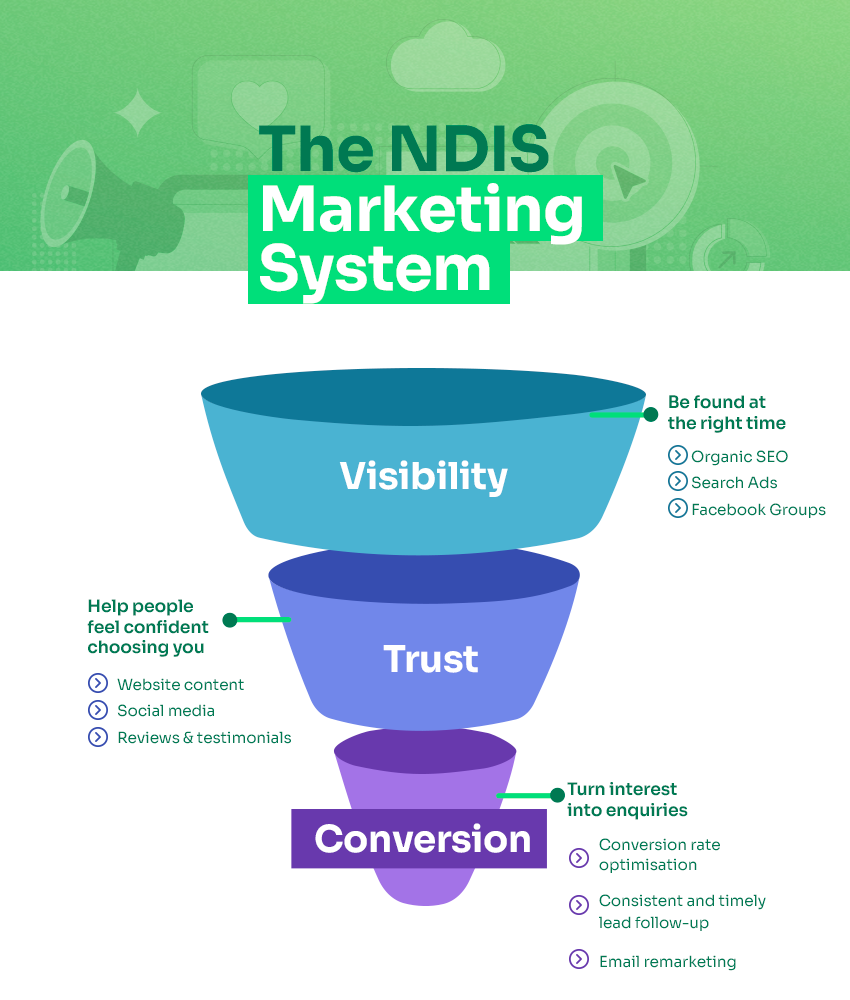
The 3-part NDIS marketing system
Effective digital marketing for NDIS providers isn’t about choosing between SEO, Google Ads or social media. It’s about how each part works together to support a decision.
At a high level, that system comes down to three parts: visibility, trust and conversion.
1. Visibility (being found at the right time)
Visibility is about showing up when someone is actively looking or asking.
For digital marketing, this typically happens through:
- Organic SEO (people searching for providers or information)
- Search ads (capturing immediate intent on Google Ads)
- Facebook Groups (contributing to community recommendations and discussions)
Each of these plays a different role, but they share one outcome; they introduce your business at the moment someone becomes aware of a need.
2. Trust (helping people feel confident in choosing you)
Once someone is aware of your business, the focus shifts from browsing to evaluating.
This is where trust is built, typically through:
- Your website (clarity, structure and messaging)
- Organic social content (consistency and credibility)
- Reviews, testimonials and real-world signals
This stage often happens quickly for some channels, and slowly for others.
Someone clicking a search ad might move through this phase in minutes. Someone engaging with your content or seeing your name in a Facebook Group may take weeks before they feel ready to reach out.
Either way, they need to feel confident that you understand their situation and can deliver the support they need.
3. Conversion (turning interest into enquiries and participants)
Conversion is where the right building blocks make a difference. With relevant visibility and trust-building activity, enquiries should be fruitful. But it doesn’t end there.
A strong conversion path should have:
- Clear pathways to make contact (website forms, phone numbers, referrals)
- Strong first interactions and response times
- Follow-up processes, including email communication
- Internal systems that ensure consistency
While this goes beyond the role of digital marketing, it’s just as worth the attention to ensure your marketing efforts pay off.
Your conversion system should also account for people who need time, reassurance or multiple touchpoints before they take the next step.
Digital marketing tactics for NDIS businesses
Organic SEO
Organic SEO plays a critical role in NDIS digital marketing because it aligns closely with how people actively look for support.
While many providers focus on broad, informative content too early, we’ve found this often misses the more immediate opportunity – showing up when someone is already considering their options.
The key is to start with consideration and not just awareness. Searches like, “NDIS provider near me”, “support coordination services [location]” and “SIL provider [area]” have higher intent for enquire and better visibility where searchers are starting to make decisions.
Once that foundation is in place, then you expand to include informational content, FAQs and guides that start to build out your reach and authority. These support earlier stages of the journey, but they work best when they sit on top of a strong consideration layer.
Local SEO
In the NDIS space, location matters. Participants, families and Support Coordinators are typically searching for providers within a specific area, which makes local SEO one of the most important factors in being found.
This includes:
- Location-specific service pages
- Consistent business information across platforms
- Optimised Google Business Profile listings
- Clear references to service areas
The goal isn’t to rank everywhere. It’s to be highly visible where you actually operate.
SEO beyond your website
A common misconception is that SEO only applies to your own website.
In reality, the same principles extend to third-party platforms where participants and Support Coordinators search for providers.
Directories and platforms like Housing Hub play a significant role in discovery, particularly for SIL and SDA services.
Applying SEO thinking here means:
- Writing clear, keyword-aligned service descriptions
- Structuring listings in a way that matches how people search
- Highlighting location, support types and key differentiators
These platforms often rank well in search results themselves, which means optimising your presence within them can significantly increase your visibility beyond your own website.
Website design
Once someone finds your business, your website becomes the most important part of the decision-making process.
In NDIS digital marketing, your website isn’t just a place to list services. It’s where participants, families and Support Coordinators decide whether you feel like the right fit.
One of the most common issues across NDIS provider websites is a lack of clarity. This often ranges from services not explained properly to an unclear process for enquiring on the website. For someone navigating the NDIS, this creates friction at exactly the point where they’re looking for reassurance.
Then, there’s NDIS website design. Good design isn’t about looking polished, it’s about helping people move forward.
That includes:
- Clear service pages aligned to specific supports
- Logical structure that guides users through information
- Accessible layouts that work for all users
- Simple, visible calls to action
It also means recognising that different visitors are at different stages.
Some are ready to enquire immediately. Others are still exploring. Your website needs to support both without overwhelming either.
Finally, your website needs to build trust. In a space built on care and responsibility, trust signals carry significant weight.
Beyond testimonials, trust signals on your website includes:
- Clear explanations of your process
- Evidence of experience and capability
- Consistency in how you communicate
- Transparency around what participants can expect
Small details matter here. If something feels unclear or incomplete, it creates doubt. And doubt slows decisions.
Before layering on advanced marketing strategies, the fundamentals need to be in place. Accessibility, structure, compliance and usability are often treated as secondary considerations, when in reality they form the baseline of trust.
If you’re unsure whether your website meets these standards, we’ve broken this down in detail in our NDIS Website Compliance Toolkit, including a full audit checklist and practical guidance on what to improve.
Search Ads
Search ads play a very specific role in NDIS digital marketing. They’re one of the few channels that can capture demand at the consideration stage, with the potential to drive high-quality enquiries.
Additionally, when someone searches for a provider, support type or service in their area, ads allow you to be visible immediately, rather than waiting for organic rankings to build over time.
Search ads often generate enquiries faster than any other channel. Someone searches, clicks, lands on your website and takes action. But without the right structure behind them, that speed can come at the expense of quality.
Common issues include:
- Broad or poorly defined keywords
- Targeting that doesn’t reflect actual service areas
- Messaging that attracts the wrong type of enquiry
The result is often a high volume of leads that don’t align with your services. Over time, that leads to wasted ad spend and internal frustration.
Search ads also play a supporting role alongside SEO. They allow you to show up for high-value searches while organic rankings are still building, test which keywords and messaging drive the best results and maintain visibility in competitive areas.
Used together, SEO and search ads create a more complete visibility strategy; one focused on both immediate and long-term growth.
Social media
Organic social has become increasingly important over the years as people spend more time on platforms, and for work-related purposes. Social media can be where you’re discovered, and where trust is built. But where most businesses fall short is by posting without person-first approach, and disregarding the community element to social media.
What matters is whether your content helps someone understand your business, the NDIS industry and their own options.
That might look like explaining how a service works in plain terms. Showing how your team approaches support. Sharing small, practical insights that make the NDIS feel easier to navigate.
Social media ads
Social media ads are completely different to search ads. As health and disability is a protected category in advertising, social media advertising requires careful consideration in how you reach the right people at the right time.
Following targeting, your messaging needs to be clear and your visibility on brand. Social media ads often need to reach people multiple times before they take action. Clear branding means that you become more recognisable after each touchpoint.
Where social media ads shine is when they are part of your full marketing picture rather than stand-alone advertising. Expecting someone to enquire after seeing one ad on Facebook is unrealistic, but using those ads to build trust so that your brand stands out from competitors is more strategic.
Organic social doesn’t need to generate enquiries to be valuable. It’s primary role is build trust and confirm that you’re a safe, reliable choice. And in the NDIS space, that confirmation is often what tips someone from considering to enquiring.
Facebook Groups
For certain industries, including NDIS, Facebook Groups can be one of the most influential discovery channels. Parents, guardians and Support Coordinators use them to ask for recommendations, share experiences and sense-check decisions.
While they aren’t polished or structured, they’re trusted. Which is why they can be so effective.
When someone asks for a recommendation in a Facebook Group, they want to hear from people who’ve been in the same position. People who’ve worked with a provider and can speak from experience. That’s why a recommendation in a group often carries more weight than a website or an ad, because it feels earned rather than presented.
However, a lot of providers treat Facebook Groups like another place to promote their services. They drop links. They post generic responses. They show up only when there’s an opportunity to get a lead. It’s easy to spot, and it rarely works.
The NDIS providers who get traction in Facebook Groups tend to approach them differently.
They show up as people first. They answer questions clearly, without overcomplicating things. They offer guidance, even when there’s no immediate benefit. They contribute to conversations rather than trying to control them.
Over time, that builds familiarity. And when someone eventually asks, “Does anyone know a good provider for this?”, those are the names that come up. Not because they advertised, but because they were present.
Email marketing
Email marketing is often treated as a follow-up tool. Someone enquires, you respond, maybe a few check-ins after that. Then it stops.
In the NDIS space, that approach leaves a large opportunity behind. Because decisions don’t always happen quickly, and more importantly, they don’t always happen in isolation.
A large portion of opportunities come through nurtured relationships with Support Coordinators, allied health professionals and other providers who are constantly connecting participants with services. They’re making recommendations, sharing options and helping guide decisions.
Email marketing helps you to build and nurture these relationships over time so that you stay relevant and top-of-mind, without being intrusive.
However, the challenge with email isn’t sending more, it’s sending something worth opening. For provider relationships, that usually means keeping things practical: updates on availability, changes to services, new offerings that might be relevant, small insights that help them better support participants.
Over time, that consistency builds familiarity, and when the right situation comes up, you’re already in mind. Because when decisions need to be made quickly, people don’t start from scratch. They go with what’s familiar and trusted.
Building trust across the full journey
If trust isn’t built alongside visibility, performance marketing starts to work harder than it needs to. More spend, more traffic, more effort, and all to compensate for something that should already be in place.
Because people don’t make decisions based on a single interaction, trust is built over the entire journey. Someone might first see your name in a Facebook Group. Then search for you on Google or ChatGPT. Then land on your website. Then check your social presence. Then come back later.
Each of those moments adds to, or takes away from, their confidence. If the experience feels consistent, clear and reliable, trust builds. However, if it feels disconnected, vague or incomplete, it resets.
Where trust is actually shaped
There’s a tendency to think of trust as something abstract. However, in reality, it’s shaped by very practical things:
- How clearly your website explains your services
- How consistent your social presence feels
- How useful your content is when someone is trying to understand their options
- How easy it is to take the next step
These aren’t separate from marketing. They are the parts of marketing that determine whether it works.
When trust is established early, everything else becomes more effective; ads convert more efficiently, website visitors stay longer and engage more, enquiries are more aligned and informed.
Without that foundation, performance marketing ends up doing more of the heavy lifting. Trying to convince instead of reinforce. And that’s where costs increase, while results stay inconsistent.
Content as a trust builder
Content plays a central role here, but not in the way it’s often approached. It’s not about producing more. It’s about curating the right information across your website and social channels so that, at any point in the journey, someone can find what they need to feel confident moving forward.
That might be:
- Clear service explanations
- Practical insights into how support works
- Content that reflects real scenarios and concerns
When done well, content doesn’t just attract attention, it reduces uncertainty, reinforces your brand and builds trust.
NDIS digital marketing isn’t short on tactics.
Most providers are already investing in SEO, running Google Ads, posting on social media, and trying to improve their online presence.
The difference is how well those pieces are connected.
When visibility, trust and conversion are aligned, marketing starts to compound. Search results bring the right people in. Your website builds confidence. Your content reinforces it. And your systems make it easy to take the next step.
For NDIS businesses looking to grow, the opportunity isn’t doing more marketing. It’s building a system that works together, one that attracts new clients, supports long-term relationships, and reflects how decisions are actually made.
At Dweebi, we work as a dedicated NDIS marketing agency, helping providers move beyond disconnected tactics and into strategies that deliver real outcomes. From NDIS websites and SEO through to digital marketing strategies and campaign management, everything is built to support growth that’s measurable, sustainable and aligned to your brand.
If you’re looking for a digital marketing agency that understands the nuance of marketing for NDIS, and knows how to build trust while driving results, we’re ready when you are.

read more!
recent posts
Construction Marketing: You’ve Outgrown Word of Mouth. What’s Next?
Word of mouth got you this far. Practical, Australia-specific construction marketing tactics for growing beyond referrals, for B2C and B2B.
Balancing Accessibility & Compliance for NDIS Website Design
If you’re an NDIS provider, your website needs to not only be accessible but compliant with NDIS guidelines.

How to Create a Construction Company Capability Statement
Learn what makes a construction company capability statement clear, professional, and visually effective to make a strong first impression.